20 Ways to improve your learning in Pre-hospital emergency care terms
My name is Laurie and I am 18 years old. I have been in this program for 2 years now and I really enjoy it. However, it's not an easy program and it can be hard to stay motivated all the time. It requires a lot of studying and practice. For this reason, I decided to create a glossary with card games and definitions to associate to make the whole process way more fun. Studying while having fun is way more interesting and motivating. My glossary is for students in the same program as me who wants to perform well in their exams. My glossary has 20 terms of medicine and languages that we can find in this job. I made a research on these words to find the correct definition and I made sure that all the resources were reliable. We are so used to use these terms in French, but when it comes to English, we don't always necessarily know what is the exact words. A lot of people in Montreal are actually speaking English so it's really relevant to know them well so we can explain it to the patient we are taking care of. You ahead and to the following card game and association game!
Ambulance
noun
A vehicle specially equipped for taking sick or injured people to and from the hospital, especially in emergencies.
Example: On the day of admission, Mr was visited at home by his GP who immediately called an ambulance.
fr: Ambulance
Bandages
noun
A strip of material used to bind a wound or to protect an injured part of the body.
Example: They had to put bandages on his leg in order to stop the bleeding.
fr: Bandages
Bones
noun
Bone, rigid body tissue consisting of cells embedded in an abundant hard intercellular material. The two principal components of this material, collagen and calcium phosphate, distinguish bone from such other hard tissues as chitin, enamel, and shell.
Example: Calcium is important for the proper growth of bones and teeth, normal blood coagulation, and muscle and nerve function.
fr: Os
Cervical collar
noun
Cervical collars are commonly used by patients who have had a surgical intervention of the cervical spine, to immobilise the neck.
Example: Her most recent bout involved her c-spine where she described pain, morning stiffness, and fatigue, loss of flexion extension lateral movements and weakness that required a cervical collar for support.
fr: Collet cervical
CPR - Cardiopulmonary resuscitation
noun
CPR – or Cardiopulmonary Resuscitation – is an emergency lifesaving procedure performed when the heart stops beating.
Example: His heart stopped beating, we had to perform CPR on him in order to keep the blood flowing into his body.
fr: RCR - Réanimation Cardio-pulmonaire
Dispatch
noun
Send off to a destination or for a purpose.
Example: We dispatch the ambulances to the closest address depending on the area they are in.
fr: Envoi
Glucometer
noun
Glucometer definition is - an instrument for measuring the concentration of glucose in the blood.
Example: He was having a seizure so we had to use the glucometer to see how much sugar he has in is blood.
fr: Glucomètre
Heart
noun
The heart is a muscular organ about the size of a fist, located just behind and slightly left of the breastbone. The heart pumps blood through the network of arteries and veins called the cardiovascular system.
Example: His physical health would deteriorate if he continued to refuse medication for a heart condition.
fr: Cœur
Heart rate monitor
noun
A heart rate monitor (HRM) is a personal monitoring device that allows one to measure/display heart rate in real time or record the heart rate for later study. It is largely used to gather heart rate data while performing various types of physical exercise.
Example: We had to put our heart rate monitor on him to see if he was doing a cardiac arrest.
fr: Moniteur de fréquence cardiaque
Lungs
noun
The lungs are a pair of spongy, air-filled organs located on either side of the chest (thorax). The trachea (windpipe) conducts inhaled air into the lungs through its tubular branches, called bronchi. The bronchi then divide into smaller and smaller branches (bronchioles), finally becoming microscopic
Example: If this was for real, the people would not be able to breathe as breathing in the ash would damage the lungs and they would suffocate and die fairly quickly.
fr: Poumons
Medication
noun
Medication (also called medicine or pharmaceutical drugs) is the use of legal drugs to treat or cure an illness.
Example: Whenever necessary he will increase the dose of his home medication to control his symptoms and initiate prednisolone if needed.
fr: Médication
Nitril gloves
noun
Disposable gloves used for patient examination and some procedures which are made from nitrile butadiene rubber.
Example: The paramedic has to put on new nitril gloves everytime he enters in contact with a new patient.
fr: Gants de nitrile
Paramedic
noun
A person trained to give emergency medical care to people who are injured or ill, typically in a setting outside of a hospital.
Example: The paramedic arrived at the destination at 12:44 pm to help this poor woman with a heart disease.
fr: Paramedic
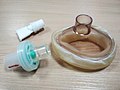
Pocket mask
noun
A pocket mask, or pocket face mask or CPR mask, is a device used to safely deliver rescue breaths during a cardiac arrest or respiratory arrest.
Example: The patient was in a respiratory arrest so we had to use our pocket mask to ventilate him properly.
fr: Masque de poche
Respiratory arrest
noun
Respiratory arrest is caused by apnea (cessation of breathing) or respiratory dysfunction severe enough it will not sustain the body (such as agonal breathing).
Example: Charlotte Wyatt, due to her intensive care needs and poor prognosis, was issued with a 'Do Not Resuscitate Order' (DNRO), so that in the event of respiratory arrest, she would not be revived.
fr: Arrêt respiratoire
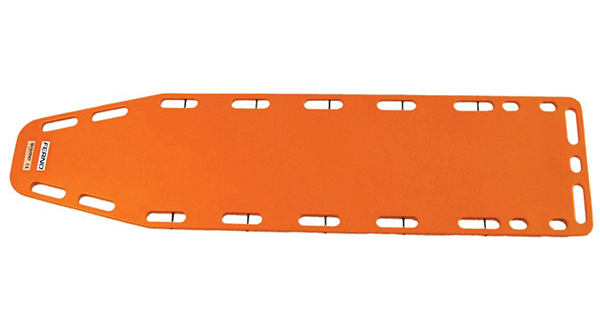
Spine board
noun
A stiff board on which an individual with a known or suspected spinal or pelvic injury is secured so that the patient's neuraxis is splinted in-line during transport.
Example: They had to put the patient on the spine board since he fell off the chair lift.
fr: Planche dorsale
Stretcher
noun
A framework of two poles with a long piece of canvas slung between them, used for carrying sick, injured, or dead people.
Example: We had to put the patient on the stretcher in order to transport her to the hospital afterwards.
fr: Civière
Surgical mask
noun
A surgical mask, also known as a medical face mask, is a personal protective equipment worn by health professionals during medical procedures to prevent airborne transmission of infections between patients and/or treating personnel, by blocking the transmission of pathogens (primarily bacteria and viruses) shed in respiratory droplets and aerosols from the wearer's mouth and nose.
Example: Because of cover, you need to put your mask every time you go in a store.
fr: Masque de chirurgie
Syringe
noun
A hollow, cylinder-shaped piece of equipment used for sucking liquid out of something or pushing liquid into something, especially one with a needle that can be put under the skin and used to inject drugs, remove small amounts of blood, etc.
Example: It is better to use a larger syringe to give a smaller injection because you don't have to draw up so far, therefore more control over needle as you plunge.
fr: Seringue
Vein
noun
Any of the tubes forming part of the blood circulation system of the body, carrying in most cases oxygen-depleted blood toward the heart.
Example: Bolus means that one dose of a drug injected into the vein all at once.